|
Douglas Fir Cladding
This product is a special order item. Please speak to us concerning your needs.
Overview
Douglas Fir is a versatile softwood that has become increasingly popular for external cladding throughout the UK. Sourced from European forests, together with selected homegrown British timber where available, it offers an excellent balance of strength, character and value.
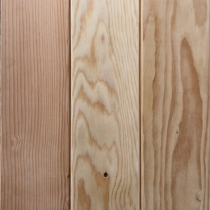
Unlike more uniform species, Douglas Fir celebrates its natural appearance. Pronounced growth rings, distinctive grain patterns and natural colour variation give each board its own individual character, making it an excellent choice for projects where a more traditional or rustic aesthetic is desired.
Its combination of performance, availability and cost-effectiveness makes Douglas Fir a popular option for residential, commercial and agricultural buildings alike.
Appearance
European Douglas Fir is typically light in colour, ranging from pale straw and honey tones through to light pinkish-brown. Its distinctive growth rings create an attractive striped grain pattern that becomes a defining feature once installed.
As a natural timber, Douglas Fir displays variation between boards. Knots, grain changes and occasional wild grain are all part of the species' natural character and contribute to the unique appearance of every installation.
Douglas Fir is also naturally resinous. Resin pockets or occasional resin bleed may occur, particularly during warmer weather, while small shakes, raised grain or minor surface flaking can develop as the timber acclimatises and weathers. These are recognised characteristics of the species and should not be considered defects.
If left untreated, Douglas Fir will gradually weather to an attractive silver-grey patina.
Durability
Douglas Fir is classified as Durability Class 3 (Moderately Durable) and, when correctly detailed, installed and maintained, offers an expected above-ground service life of 30+ years.
Correct detailing, ventilation and moisture management remain essential to maximise the lifespan of any external timber cladding system.
Dimensional Stability
Douglas Fir offers good dimensional stability for an untreated softwood. Whilst some seasonal movement is to be expected, correct installation techniques and appropriate expansion allowances will ensure excellent long-term performance.
Treatment & Maintenance
Douglas Fir can be left untreated to weather naturally or protected with a high-quality exterior wood oil or UV-resistant coating to help preserve its natural colour.
Any applied finish should be maintained in accordance with the coating manufacturer's recommendations.
Recommended Fixings
For the best long-term performance, we recommend:
- A2 Stainless Steel Fixings
- A4 Stainless Steel Fixings for coastal or highly exposed environments
Using stainless steel fixings helps prevent staining and provides long-term corrosion resistance.
Typical Applications
Douglas Fir is well suited to a wide range of external cladding projects, including:
- Residential homes
- Contemporary new builds
- Barn conversions
- Garden rooms
- Commercial developments
- Agricultural buildings
- Feature walls
- Soffits and fascias
Why Choose Douglas Fir?
- Excellent balance of appearance, strength and value.
- Distinctive striped grain with plenty of natural character.
- Readily available from European and selected British sources.
- Good dimensional stability.
- Suitable for both traditional and contemporary designs.
- Can be left to weather naturally or coated to retain its original colour.
- Sustainably sourced from responsibly managed forests.
|


 OGL Software